- Home
- Tutorial
- Resource Guides
- Focus Areas
- LSF Programs
-
Professional
Development - Review Process
-
A project of LSF

Search for Resources
Description
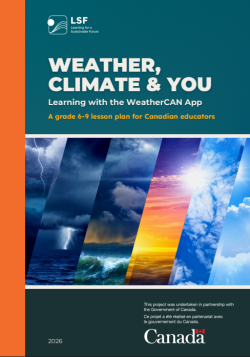
This resource uses the WeatherCAN app to help students explore the relationship between weather, climate, and daily decision-making. Students learn to interpret real-time weather data and forecasts while developing an understanding of how weather differs from long-term climate patterns. They also examine Canadian weather patterns, how these are influenced by climate change, and how communities can adapt to these changes.
Through hands-on activities such as tracking weather over time, identifying patterns, and reflecting on personal experiences, students deepen their understanding of how weather affects their daily lives. The lesson also builds awareness of climate change and extreme weather, emphasizing the importance of reliable information for safety and planning. These learning experiences are supported using the WeatherCAN app as a key instructional tool.
Lesson 1: Exploring Canadian Weather Patterns and Impacts - In this lesson, students investigate how weather patterns across Canada impact agriculture, transportation, tourism, and culture, using real-time weather data and Indigenous perspectives on environmental monitoring.
Lesson 2: Adaptation and Resilience to Weather and Climate Change in Canada - In this lesson, students analyze how communities adapt to extreme weather and climate conditions using real weather data from the WeatherCAN app, while considering both modern technology and Traditional Ecological Knowledge.
Each lesson includes hands-on activities that require printed materials provided in the resource.
General Assessment
Strengths
- Well organized and easy to use, with clear learning outcomes, materials and preparation steps
- Includes real-world learning with the use of the WeatherCAN app and real-time data
- Includes an experiential activity
- Indigenous perspectives are woven into the the lesson plans
- Promotes understanding of climate change and adaptation strategies
Weaknesses
- Limtied opportunities for student action beyond planning and presenting
- Limited opportunites for outdoor or nature-based connection beyond observation
Recommendation of how and where to use it
This lesson plan was developed for grades 6–9 but would also be suitable for grade 5, as students at this level study weather as part of the science curriculum.
Relevant Curriculum Units
The following tool will allow you to explore the relevant curriculum matches for this resource. To start, select a province listed below.
- Step 1Select a province
- Alberta
- Step 2Select a grade level
- Grade 5
- Step 3Select a subject
- Science
- Step 4Relevant matches
- Earth Systems: Understandings of the living world, Earth, and space are deepened by investigating natural systems and their interactions.
- Social Studies
- Step 4Relevant matches
- Citizenship: Understanding local, national, and global issues empowers individual and collective action toward an inclusive society
- Grade 6
- Step 3Select a subject
- Science
- Step 4Relevant matches
- Earth Systems: Understandings of the living world, Earth, and space are deepened through investigating natural systems and their interactions.
- Grade 9
- Step 3Select a subject
- Environmental Science
- Step 4Relevant matches
- Environment and Outdoor Education: Environmental Investigations
- British Columbia
- Manitoba
- Newfoundland & Labrador
- Step 2Select a grade level
- Grade 5
- Step 3Select a subject
- Science
- Step 4Relevant matches
- Weather
- Grade 6
- Step 3Select a subject
- Social Studies
- Step 4Relevant matches
- How Can We Be Good Global Citizens?
- Northwest Territories
- Nova Scotia
- Step 2Select a grade level
- Grade 5
- Step 3Select a subject
- Information Technology
- Step 4Relevant matches
- Information and Communication Technology 5: Research, Problem Solving and Decision Making
- Science
- Step 4Relevant matches
- Science 5: Weather
- Grade 6
- Step 3Select a subject
- Information Technology
- Step 4Relevant matches
- Information and Communication Technology 6: Productivity and Innovation
- Grade 7
- Step 3Select a subject
- Science
- Step 4Relevant matches
- Science 7: Environmental Action
- Grade 8
- Step 3Select a subject
- Science
- Step 4Relevant matches
- Science 8: Climate Change
- Nunavut
- Ontario
- Step 2Select a grade level
- Grade 5
- Step 3Select a subject
- Science & Technology
- Step 4Relevant matches
- STEM Skills and Connections
- Grade 6
- Step 3Select a subject
- Science & Technology
- Step 4Relevant matches
- STEM Skills and Connections
- Grade 7
- Step 3Select a subject
- Geography
- Step 4Relevant matches
- Physical Patterns in a Changing World
- Science & Technology
- Step 4Relevant matches
- STEM Skills and Connections
- Prince Edward Island
- Saskatchewan
- Yukon Territory
Themes Addressed
Air, Atmosphere & Climate (2)
- Climate Change
- Weather
Indigenous Knowledge (2)
- Etuaptmumk/Two-Eyed Seeing
- TEK -- Traditional Ecological Knowledge
Science and Technology (2)
- Alternative Ways of Doing Science
- Analysing Conventional Science
Sustainability Education Principles
| Principle | Rating | Explanation |
|---|---|---|
| Consideration of Alternative Perspectives | Very Good | This resource does consider alternative perspectives through the inclusion of Traditional Ecological Knowledge and Western scientific approaches. Students are introduced to Indigenous ways of understanding weather and climate through observation of the land, animals, and sky, and how these observations can be used to interpret and predict weather patterns. This is presented with the use of the WeatherCAN app and conventional meteorological data, allowing students to recognize that there are multiple ways of understanding and interpreting environmental conditions. |
Consideration of Alternative Perspectives:
| ||
| Multiple Dimensions of Problems & Solutions | Very Good | This resource addresses the three dimensions of the issues being explored. The environmental dimension focuses on weather, climate, and climate change. The economic dimension is shown through the impact of weather on agriculture, transportation, and tourism. The social dimension is included by examining how weather affects daily life, safety, and community responses. |
| Multiple Dimensions of Problems & Solutions: Effectively addresses the environmental, economic and social dimensions of the issue(s) being explored.
| ||
| Respects Complexity | Very Good | The lessons explore how weather patterns across Canada impact agriculture, transportation, tourism, and culture using real-time data and Indigenous perspectives. They also examine how communities adapt to extreme weather and the strategies people use to respond to climate challenges. |
| Respects Complexity: The complexity of the problems/issues being discussed is respected. | ||
| Acting on Learning | Good | The lessons involve identifying and designing adaptation strategies, for a scenario provided by the teacher. The learning is mainly focused on planning and discussion, with limited opportunities for students to implement changes in their personal lives, school, or community. |
| Acting on Learning: Learning moves from understanding issues to working towards positive change — in personal lifestyle, in school, in the community, or for the planet
| ||
| Values Education | Satisfactory | Some implicit reflection may occur through discussion and reflection on how weather and climate affect students’ daily lives and decisions. Indigenous perspectives can prompt reflection on different ways of valuing and relating to the environment. |
| Values Education: Students are explicitly provided with opportunities to identify, clarify and express their own beliefs/values. | ||
| Empathy & Respect for Humans | Good | The resource recognizes the importance of Traditional Ecological Knowledge, which uses observations of land, animals, and sky to understand and predict weather patterns. |
| Empathy & Respect for Humans: Empathy and respect are fostered for diverse groups of humans (including different genders, ethnic groups, sexual preferences, etc.). | ||
| Personal Affinity with Earth | Good | Students observe real weather in their local environment and reflect on how communities plan, build, and respond to stay safe and resilient during extreme weather events caused by a changing climate. |
| Personal Affinity with Earth: Encourages a personal affinity with -the natural world.
| ||
| Locally-Focused Learning | Good | Students identify weather conditions in different provinces and territories using the WeatherCAN app and learn how weather can affect their local region. They compare WeatherCAN forecasts with their observations during an experiential observation walk. |
| Locally-Focused Learning: Includes learning experiences that take advantage of issues/elements within the local community.
| ||
| Past, Present & Future | Good | Students engage with current weather conditions and real-time data using the WeatherCan app, helping them understand what is happening in the world around them. The lessons also include learning about adaptation strategies for extreme weather and climate change, encouraging students to think about how communities can respond to and prepare for future conditions. |
| Past, Present & Future: Promotes an understanding of the past, a sense of the present, and a positive vision for the future. | ||
Pedagogical Approaches
| Principle | Rating | Explanation |
|---|---|---|
| Open-Ended Instruction | Very Good | The resource includes some open-ended instruction by allowing students to generate their own solutions and actions within guided tasks. |
| Open-Ended Instruction
: Lessons are structured so that multiple/complex answers are possible; students are not steered toward one 'right' answer. | ||
| Integrated Learning | Good |
|
| Integrated Learning: Learning brings together content and skills from more than one subject area
| ||
| Inquiry Learning | Good | This lesson reflects guided inquiry learning, as the teacher provides a central question or focus while students actively explore and construct their understanding. Students investigate how weather and climate affect their daily lives and decisions through discussion, observation, and the use of WeatherCAN and real-time data. The teacher supports the process by providing guiding questions, but students are encouraged to analyze information and share their reflections. While the learning path is supported, students still have opportunities to think critically and develop their own adaptation plan for a given scenario. |
| Inquiry Learning: Learning is directed by questions, problems, or challenges that students work to address.
| ||
| Differentiated Instruction | Very Good | The resource includes a variety of activities and open-ended tasks. It also provides a suggested list of differentiated strategies so teachers can tailor the instruction to students’ needs based on their readiness, interests and learning styles. |
| Differentiated Instruction: Activities address a range of student learning styles, abilities and readiness.
| ||
| Experiential Learning | Good | Students engage with real-world contexts by using tools such as WeatherCAN and real-time weather data, helping them connect their learning to actual environmental conditions and everyday decision-making. This makes the learning authentic, as it reflects issues and tools used outside the classroom. The resource also integrates Traditional Ecological Knowledge by valuing Indigenous perspectives on relationships with the land and the environment, enriching students’ understanding by offering different ways of knowing and interpreting climate and ecological changes. It is also experiential learning, as students actively participate in observing, discussing, and reflecting on weather and climate, as well as applying their understanding through scenario-based adaptation planning. These hands-on and reflective activities allow students to learn by doing and by making meaningful connections to real-life situations. |
| Experiential Learning: Authentic learning experiences are provided
| ||
| Cooperative Learning | Satisfactory | Most activities are in a group setting, where students work with a partner or group. |
| Cooperative Learning: Group and cooperative learning strategies are a priority.
| ||
| Assessment & Evaluation | Good | The resource provides Assessments For Learning -Observation during exploration with WeatherCAN app and Assessment AS Learning - Student responses during discussion and an exit reflection |
| Assessment & Evaluation: Tools are provided that help students and teachers to capture formative and summative information about students' learning and performance. These tools may include reflection questions, checklists, rubrics, etc. | ||
| Peer Teaching | Good | Each group gives a two-minute presentation of their adaptation plan. |
| Peer Teaching: Provides opportunities for students to actively present their knowledge and skills to peers and/or act as teachers and mentors.
| ||
| Case Studies | Poor/Not considered | Not considered in this resource. |
| Case Studies: Relevant case studies are included. Case studies are thorough descriptions of real events from real situations that students use to explore concepts in an authentic context. | ||
| Locus of Control | Good | The resource provides some opportunities for student choice, particularly in selecting ideas, solutions, and ways to express their learning, such as through discussions, writing, or presentations. |
| Locus of Control: Meaningful opportunities are provided for students to choose elements of program content, the medium in which they wish to work, and/or to go deeper into a chosen issue. | ||