- Home
- Tutorial
- Resource Guides
- Focus Areas
- LSF Programs
-
Professional
Development - Review Process
-
A project of LSF

Search for Resources
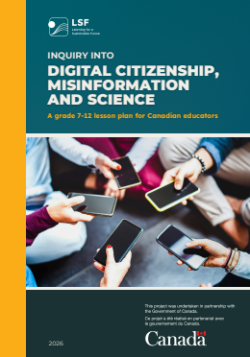
Inquiry Into Digital Citizenship, Misinformation and Science
A grade 7-12 lesson plan for Canadian educators
Secondary
Description
This resource engages students in inquiry-based learning focused on digital citizenship, disinformation/ misinformation, and scientific thinking. Through interactive activities, students learn to distinguish fact from opinion, evaluate the credibility of media, and apply critical thinking skills to identify misinformation and science denial. The lesson culminates in a task that allows students to demonstrate their understanding.
Students will:
- Understand the difference between fact and opinion
- Learn strategies to evaluate visual, text and social media for validity, misinformation and disinformation
- Understand the importance of their responsibility as critical thinkers and as Digital Citizens
- Apply their understanding of the scientific method and basic methods of science denial and media misinformation
- Demonstrate their knowledge and skills through active learning activities and a culminating task
The lesson promotes responsible digital citizenship and evidence-based reasoning while encouraging students to reflect on their own information consumption habits. Extension opportunities are included to deepen student understanding of misinformation in digital spaces.
General Assessment
Strengths
- The lesson topic is current and relevant to students’ lives because it focuses on digital citizenship and online information.
- It helps students build critical thinking and media literacy skills to deal with misinformation.
- Optional activities are included to support different student needs and allow for flexibility.
- The examples relate to current issues about online information and science communication.
- The inquiry-based approach encourages engagement through discussion and real-world scenarios.
- Tools and supports are provided to help guide student learning.
- Well organized and easy to use, with clear learning outcomes, materials and preparation steps
Relevant Curriculum Units
The following tool will allow you to explore the relevant curriculum matches for this resource. To start, select a province listed below.
- Step 1Select a province
- Alberta
- Step 2Select a grade level
- Grade 9
- Step 3Select a subject
- English/Language Arts
- Step 4Relevant matches
- Comprehend and respond personally and critically to oral, print, and other media texts
- British Columbia
- Step 2Select a grade level
- Grade 9
- Step 3Select a subject
- English/Language Arts
- Step 4Relevant matches
- Questioning what we hear, read, and view contributes to our ability to be educated and engaged citizens.
- Grade 10
- Step 3Select a subject
- English/Language Arts
- Step 4Relevant matches
- Literary Studies 10: Questioning what we hear, read, and view contributes to our ability to be educated and engaged citizens
- New Media 10: Digital citizens have rights and responsibilities in an increasingly globalized society.
- Grade 11
- Step 3Select a subject
- English/Language Arts
- Step 4Relevant matches
- Literary Studies 11: Questioning what we hear, read, and view contributes to our ability to be educated and engaged citizens.
- New Media 11: Digital citizenship requires both knowledge of digital technology and awareness of its impact on individuals and society
- Grade 12
- Step 3Select a subject
- English/Language Arts
- Step 4Relevant matches
- English Studies 12: Questioning what we hear, read, and view contributes to our ability to be educated and engaged citizens.
- New Media !2: Digital citizens have rights and responsibilities in an increasingly globalized society.
- Manitoba
- Step 2Select a grade level
- Grade 9
- Step 3Select a subject
- English/Language Arts
- Step 4Relevant matches
- Comprehend and respond personally and critically to oral, print, and other media texts
- Grade 10
- Step 3Select a subject
- English/Language Arts
- Step 4Relevant matches
- Manage ideas and information
- Grade 11
- Step 3Select a subject
- English/Language Arts
- Step 4Relevant matches
- Manage ideas and information
- New Brunswick
- Step 2Select a grade level
- Grade 12
- Step 3Select a subject
- English/Language Arts
- Step 4Relevant matches
- Journalism 120: Propaganda, Sensationalism, News
- Journalism 120: The Medium and the Message
- Newfoundland & Labrador
- Step 2Select a grade level
- Grade 10
- Step 3Select a subject
- English/Language Arts
- Step 4Relevant matches
- Literacy 1204: Inquiry and Critical Thinking
- Northwest Territories
- Step 2Select a grade level
- Grade 9
- Step 3Select a subject
- English/Language Arts
- Step 4Relevant matches
- Questioning what we hear, read, and view contributes to our ability to be educated and engaged citizens.
- Grade 10
- Step 3Select a subject
- English/Language Arts
- Step 4Relevant matches
- Literary Studies 10: Questioning what we hear, read, and view contributes to our ability to be educated and engaged citizens
- New Media 10: Digital citizens have rights and responsibilities in an increasingly globalized society.
- Grade 11
- Step 3Select a subject
- English/Language Arts
- Step 4Relevant matches
- Literary Studies 11: Questioning what we hear, read, and view contributes to our ability to be educated and engaged citizens.
- New Media 11: Digital citizenship requires both knowledge of digital technology and awareness of its impact on individuals and society
- Grade 12
- Step 3Select a subject
- English/Language Arts
- Step 4Relevant matches
- English Studies 12: Questioning what we hear, read, and view contributes to our ability to be educated and engaged citizens.
- New Media !2: Digital citizens have rights and responsibilities in an increasingly globalized society.
- Nova Scotia
- Step 2Select a grade level
- Grade 9
- Step 3Select a subject
- Social Studies
- Step 4Relevant matches
- Citizenship 9: Digital Citizenship
- Grade 11
- Step 3Select a subject
- English/Language Arts
- Step 4Relevant matches
- Reading & Viewing
- Nunavut
- Step 2Select a grade level
- Grade 9
- Step 3Select a subject
- English/Language Arts
- Step 4Relevant matches
- Comprehend and Respond
- Ontario
- Step 2Select a grade level
- Grade 9
- Step 3Select a subject
- English/Language Arts
- Step 4Relevant matches
- Literacy Connections and Applications
- Grade 10
- Step 3Select a subject
- Civic Studies
- Step 4Relevant matches
- Civics and Citizenship (Open): Civic Engagement and Action
- English/Language Arts
- Step 4Relevant matches
- English: Media Studies
- Grade 11
- Step 3Select a subject
- English/Language Arts
- Step 4Relevant matches
- Media Studies (Open) Media and Society
- Media Studies (Open) Understanding & Interpreting Media Texts
- Grade 12
- Step 3Select a subject
- English/Language Arts
- Step 4Relevant matches
- English: Media Studies
- Saskatchewan
- Step 2Select a grade level
- Grade 10
- Step 3Select a subject
- English/Language Arts
- Step 4Relevant matches
- English Language Arts A10: Comprehend and Respond
- Grade 11
- Step 3Select a subject
- English/Language Arts
- Step 4Relevant matches
- Journalism Studies
- Media Studies
- Yukon Territory
- Step 2Select a grade level
- Grade 9
- Step 3Select a subject
- English/Language Arts
- Step 4Relevant matches
- Questioning what we hear, read, and view contributes to our ability to be educated and engaged citizens.
- Grade 10
- Step 3Select a subject
- English/Language Arts
- Step 4Relevant matches
- Literary Studies 10: Questioning what we hear, read, and view contributes to our ability to be educated and engaged citizens
- New Media 10: Digital citizens have rights and responsibilities in an increasingly globalized society.
- Grade 11
- Step 3Select a subject
- English/Language Arts
- Step 4Relevant matches
- Literary Studies 11: Questioning what we hear, read, and view contributes to our ability to be educated and engaged citizens.
- New Media 11: Digital citizenship requires both knowledge of digital technology and awareness of its impact on individuals and society
- Grade 12
- Step 3Select a subject
- English/Language Arts
- Step 4Relevant matches
- English Studies 12: Questioning what we hear, read, and view contributes to our ability to be educated and engaged citizens.
- New Media !2: Digital citizens have rights and responsibilities in an increasingly globalized society.
Themes Addressed
Citizenship (1)
- Media
Science and Technology (1)
- Appropriate Technology
Sustainability Education Principles
| Principle | Rating | Explanation |
|---|---|---|
| Consideration of Alternative Perspectives | Very Good | Students are equipped with practical digital literacy skills that help them critically evaluate online information, participate responsibly in the digital world, and consider different points of view. |
Consideration of Alternative Perspectives:
| ||
| Multiple Dimensions of Problems & Solutions | Poor/Not considered | Although not explicitly addressed in the lesson, there is potential to explore the interconnected impacts of misinformation and disinformation across these dimensions. |
| Multiple Dimensions of Problems & Solutions: Effectively addresses the environmental, economic and social dimensions of the issue(s) being explored.
| ||
| Respects Complexity | Very Good | This lesson teaches students to distinguish fact from opinion, evaluate the credibility of media, and apply critical thinking skills to identify misinformation and science denial. It equips student with the necessary skills to evaluate visual, text and social media for validity. |
| Respects Complexity: The complexity of the problems/issues being discussed is respected. | ||
| Acting on Learning | Good | The resource includes an opportunity for students to create an illustrated poster that communicates a strategy for identifying misinformation. Students share their learning by selecting a location to display their poster, supporting peer education and awareness within the school community. |
| Acting on Learning: Learning moves from understanding issues to working towards positive change — in personal lifestyle, in school, in the community, or for the planet
| ||
| Values Education | Good | Opportunities are provided to allow students to discuss the information presented and express their understanding of the issues. |
| Values Education: Students are explicitly provided with opportunities to identify, clarify and express their own beliefs/values. | ||
| Empathy & Respect for Humans | Poor/Not considered | Not considered in this resource |
| Empathy & Respect for Humans: Empathy and respect are fostered for diverse groups of humans (including different genders, ethnic groups, sexual preferences, etc.). | ||
| Personal Affinity with Earth | Poor/Not considered | Not considered in this resource |
| Personal Affinity with Earth: Encourages a personal affinity with -the natural world.
| ||
| Locally-Focused Learning | Good | Students develop the skills to critically, effectively, and responsibly access, understand, and engage with information in the news and on social media. |
| Locally-Focused Learning: Includes learning experiences that take advantage of issues/elements within the local community.
| ||
| Past, Present & Future | Satisfactory | The lesson suggests that traditional news sources have declined over time while social media has become a main source of information. This change is linked to current and future concerns about misinformation and its impact on an informed population. |
| Past, Present & Future: Promotes an understanding of the past, a sense of the present, and a positive vision for the future. | ||
Pedagogical Approaches
| Principle | Rating | Explanation |
|---|---|---|
| Open-Ended Instruction | Good | Students explore a range of strategies for evaluating online information and apply these skills through guided activities that focus on identifying misinformation and assessing the credibility of media sources. They demonstrate their understanding by creating a poster that communicates one of the strategies learned. |
| Open-Ended Instruction
: Lessons are structured so that multiple/complex answers are possible; students are not steered toward one 'right' answer. | ||
| Integrated Learning | Good |
|
| Integrated Learning: Learning brings together content and skills from more than one subject area
| ||
| Inquiry Learning | Good | This resource uses an inquiry-based approach where students learn by exploring, questioning and applying strategies to real examples of media and online information. Students actively investigate the credibility of sources and the presence of misinformation, using guided tools and criteria to support their thinking. Through discussion, analysis, and a culminating task, they construct their own understanding and demonstrate their learning by applying critical thinking skills. |
| Inquiry Learning: Learning is directed by questions, problems, or challenges that students work to address.
| ||
| Differentiated Instruction | Very Good | The resource provides a suggested list of differentiated strategies so teachers can tailor the instruction to students’ needs based on their readiness, interests and learning styles. |
| Differentiated Instruction: Activities address a range of student learning styles, abilities and readiness.
| ||
| Experiential Learning | Good | The resource provides an authentic learning experience by teaching students critical thinking skills to identify misinformation in real-world media and online contexts. They learn strategies to evaluate visual, text and social media for validity, misinformation and disinformation. |
| Experiential Learning: Authentic learning experiences are provided
| ||
| Cooperative Learning | Satisfactory | Students work in groups. |
| Cooperative Learning: Group and cooperative learning strategies are a priority.
| ||
| Assessment & Evaluation | Good | Assessment strategies include teacher observation during discussions, ongoing assessment as students apply evaluation strategies to media, class discussions, illustrated poster depicting a misinformation strategy and student reflection. |
| Assessment & Evaluation: Tools are provided that help students and teachers to capture formative and summative information about students' learning and performance. These tools may include reflection questions, checklists, rubrics, etc. | ||
| Peer Teaching | Satisfactory | The resource suggest as a next step to create a digital collection of the posters to use in other classes or with parents. |
| Peer Teaching: Provides opportunities for students to actively present their knowledge and skills to peers and/or act as teachers and mentors.
| ||
| Case Studies | Poor/Not considered | Not considered in this resource. |
| Case Studies: Relevant case studies are included. Case studies are thorough descriptions of real events from real situations that students use to explore concepts in an authentic context. | ||
| Locus of Control | Satisfactory | Students have options for creating their posters. They are encouraged to uses images and brief words while conveying their message. |
| Locus of Control: Meaningful opportunities are provided for students to choose elements of program content, the medium in which they wish to work, and/or to go deeper into a chosen issue. | ||